
Specifying Concrete Shuttering Boards: A Practical Guide
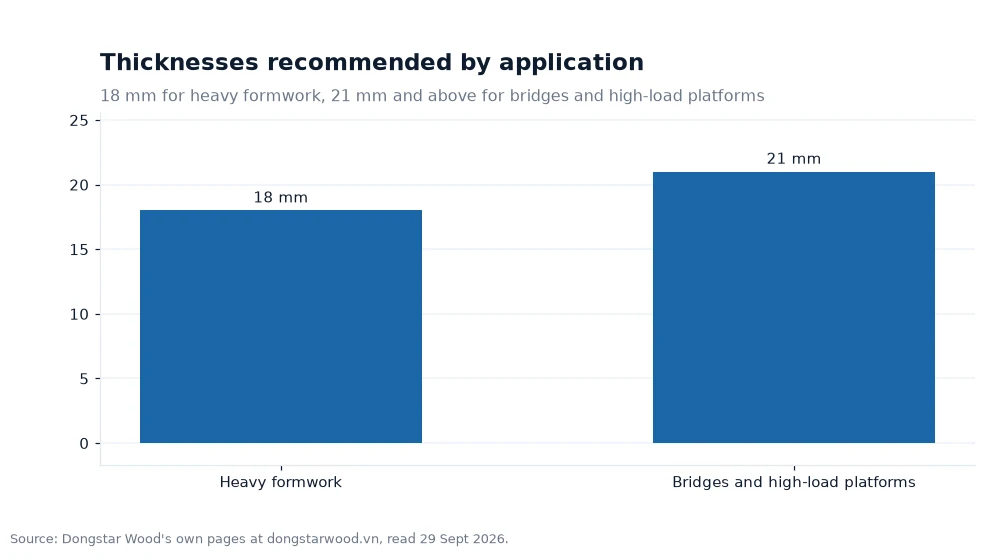
A shuttering board is specified against the pour it will face: the load, the number of cycles, and the finish the concrete must leave. The published range covers 1220 × 2440 mm, 1250 × 2500 mm and 1500 × 3000 mm sheets up to custom panels at 1830 × 3830 mm, 18 mm is the heavy-formwork choice, while bridges and high-load platforms take 21 mm and above.
Key takeaways
- The standard size range spans 1220 × 2440 mm up to bespoke panels of 1830 × 3830 mm; heavy formwork calls for 18 mm, while bridges and high-load platforms need 21 mm or thicker.
- Reuse for high-grade formwork plywood runs up to 10–20 times in concrete pouring projects.
- The smooth surface carries a published film weight of 165 g/㎡; the other option is 130 g/㎡.
- Cores cover Birch, Eucalyptus, Acacia, White Hardwood, Rubber and Combi; adhesives cover E0, E1, E2, MR, WBP and Phenolic Dynea.
Read the pour before the panel
The category page for formwork plywood — as the client calls it — lists the sizes, films, cores and adhesives a specifier needs before a single sheet is ordered. The page is organised around the product's life on site: a board is bought, carried to a form, struck, cleaned, carried back and poured against again, and the specification that survives that cycle is the one written from the pour backwards.
Start with the element. A column form, a beam soffit and a wall face each load the board differently, and the published thicknesses answer in millimetres: 18 mm for heavy formwork and as the best overall choice, while bridges and high-load platforms take 21 mm and above. The category page for Film Faced Plywood lists those thicknesses alongside six core options and the film weights behind the surface, so the specifier can match the board to the pour rather than guessing at a catalogue.
Size the sheet to the form
Three standard formats are published — 1250 × 2500 mm, 1500 × 3000 mm and 1220 × 2440 mm — with bespoke panels reaching 1830 × 3830 mm. Choosing among them is a joint-count exercise: wider and longer sheets reduce the seams across a form face, and every seam is a point where concrete can bleed through, the surface finish can break down and striking can drag. A wall pour benefits from the largest sheet the crew can manoeuvre; a column form favours a format that wraps the shape without producing offcuts.
Handling sets the upper bound. A 1500 × 3000 mm sheet covers 1500 mm × 3000 mm = 4.5 m², which is impressive on paper and awkward on a crowded deck. The 1220 × 2440 mm and 1250 × 2500 mm formats exist because two workers can place them, and a specification that cannot be placed is only a number.
Thickness: 18 mm and 21 mm
The thickness guidance is short and deliberate. 18 mm serves as the heavy formwork choice and the best overall option across the range; bridges and high-load platforms are reserved 21 mm and above, where the span between supports and the weight of wet concrete push a thin board past its deflection limit. The 3 mm difference between them is the difference between a board that holds its plane and one that drums. The category page lists those thicknesses alongside six core options and the film weights behind the surface, so the specifier can match the board to the pour rather than guessing at a catalogue.
Deflection is the failure mode to design against. A board that bows under wet concrete gives back a bowed column, and no amount of patching hides it. Where the form design leaves a long unsupported span — a tall wall with wide tie spacing, a deep beam soffit — the 21 mm choice is the cheaper mistake to avoid.
Film, core and glue
The surface is where the board meets the concrete. The page offers Dark Brown Film, Black Film and Anti Slip Film, the smooth surface carries a published film weight of 165 g/㎡, and the other option 130 g/㎡. The phenolic film surface releases cleanly from cured concrete and protects the veneers beneath it through repeated pours, which is what makes the reuse arithmetic work at all.
Beneath the film, the core carries the load. Cores run Birch, Eucalyptus, Acacia, White Hardwood, Rubber and Combi, and the adhesives that bond them run E0, E1, E2, MR, WBP and Phenolic Dynea. For exterior and wet conditions the WBP and Phenolic Dynea options are the ones that keep the layers bonded through repeated wetting and drying on site.
Reuse and site care
The published reuse figure — reuse of high-grade formwork plywood runs up to 10–20 times in concrete pouring projects — is a span, not a promise. Where a board lands in the span depends on handling, storage and edge protection: a board stacked flat, edged and covered outlasts one dragged across a deck. The specification should plan against the low end first, so the programme budget survives even a hard site.
Striking practice matters as much as stacking. A board levered off a form with a crowbar tears the film at the edges, and a torn edge wicks water into the veneers on the next pour. The boards that reach the top of the reuse span are the ones struck with a proper wedge and cleaned before the concrete sets.
| Application | Thickness | Film | Core | Reuse note |
|---|---|---|---|---|
| Heavy formwork | 18 mm | Dark brown or black | Birch, Eucalyptus, Acacia | Up to 10–20 cycles with edge care |
| Bridges and high-load platforms | 21 mm and above | Dark brown or black | Birch or Combi | Plan against the low end of the span |
| Anti-slip access surfaces | 9–21 mm | Anti Slip Film | Combi or hardwood | Grip surface, single or double face |
| Custom forms | 18–21 mm | Dark brown or black | White Hardwood, Rubber | Custom panels up to 1830 × 3830 mm |
Worked example: contact area per sheet
A single 1250 × 2500 mm sheet yields 1250 × 2500 = 3.125 m² of contact area. Worked across the published reuse range, ten pours produce 10 × 3.125 = 31.25 m² per sheet, while twenty pours produce 20 × 3.125 = 62.5 m² — the difference between a board consumed by one job and one that amortises across several. The difference between those two figures is the difference between a board that is consumed by the project and one that amortises across it.
Scale the same arithmetic to a programme. Two hundred sheets at the low end deliver 200 × 31.25 = 6,250 m² of contact area; at the high end the same stack delivers 12,500 m². A buyer comparing board prices is really comparing those two totals, and the film weight — 165 g/㎡ versus 130 g/㎡ — is part of how the higher figure is reached.
Frequently asked questions
Which thickness should a shuttering board be?
The published guidance puts 18 mm as the heavy formwork choice and the best overall option, while 21 mm and above serves bridges and high-load platforms. The thickness is matched to the load the form will carry, not to the price per sheet.
How many times can a formwork board be reused?
Reuse for high-grade formwork plywood runs up to 10–20 times in concrete pouring projects, provided edges and surface are maintained. The reuse range is published as a span, because site conditions — handling, storage, edge protection — decide where in the span a given board lands.
What cores and adhesives are available?
Cores cover Birch, Eucalyptus, Acacia, White Hardwood, Rubber and Combi, and adhesives cover E0, E1, E2, MR, WBP and Phenolic Dynea. The film surface can be dark brown, black or anti-slip; the smooth surface is 165 g/㎡ and the other option 130 g/㎡.
From specification to striking
Once the board is specified, the next question is which surface the project actually needs. The wire mesh range adds a textured, slip-resistant face for access platforms and walkboards, while the ordinary black range covers standard pours where an economical acacia-cored board is the right tool. Both come from the same press line, which is what lets one specification cover a whole site.
Numerical claims here rest on data published by the company's published web pages consulted on 29 September 2026[1].